Parliament was plunged into darkness just as President Emmerson Mnangagwa stood to deliver his State of the Nation Address. What was meant to be a display of strength and stability turned into a metaphor for national failure. The president, surrounded by top officials, finished his speech under torchlight. The shadows dancing on the walls reflected not just flickering bulbs but the dimming hope of a nation ruled by the same party for forty five years.
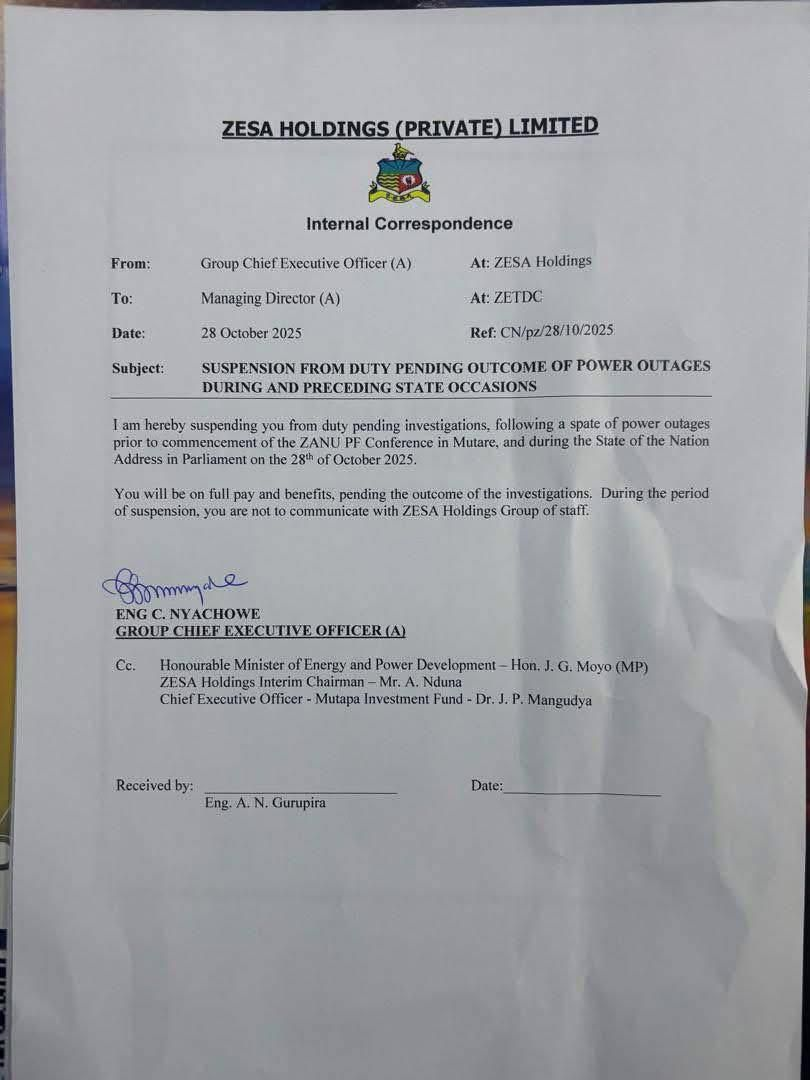
Within hours of the blackout, the Zimbabwe Electricity and Distribution Company’s Managing Director Abel Gurupira was suspended. The government moved with unusual speed. Officially, it was to allow investigations into what caused the outage. Unofficially, it looked like panic. Energy Minister July Moyo and ZESA boss Cletus Nyachowe scrambled to act under pressure from Mnangagwa and Speaker of Parliament Jacob Mudenda. Mudenda was reportedly furious and demanded heads roll. Gurupira’s suspension seemed less about accountability and more about political survival.
Yet no one can say with certainty what caused the blackout. Parliament’s spokesperson says it was a technical fault. Others whisper about sabotage. Mudenda himself believes foul play is possible. Either way, this is not the first time such an outage has hit the seat of government. The recurrence only deepens public suspicion. If it is sabotage, then the state is collapsing from within. If it is a fault, then it is just another sign of national decay.
For ordinary Zimbabweans, the lights have been off for years. Power cuts are normal. Clinics shut down. Children study by candlelight. Businesses grind to a halt. But when the same reality touches the ruling elite, it becomes a crisis. That double standard is infuriating. What Zimbabweans witnessed yesterday was more than an embarrassing moment. It was symbolic. A regime that has sucked the life out of every institution now finds itself literally and figuratively in the dark.
It was poetic justice. Mnangagwa read his vision for the future while wrapped in darkness. The symbolism was inescapable. The government is in the dark. Its policies are in the dark. The country is stumbling forward with no light to guide it. The torchlight did not reveal hope. It revealed how far we have fallen.
The aftermath was chaotic. Instead of focusing on solutions, leaders began pointing fingers. There was no sense of order or strategy. Just blame and cover-ups. And while the ZANU PF elite panicked, the ordinary people remained where they have always been. In the shadows. Forgotten. Powerless. The suspension of one official will not restore electricity to the millions who suffer daily. It will not fix the broken grid or stop the looting of public funds. It changes nothing because the rot is deeper than any one individual.
What the world saw yesterday was a moment of truth. No amount of propaganda could hide it. No speech could explain it away. The ruling party has led this country into darkness. And now even they cannot escape it. Torchlight cannot mask failure. It can only highlight it. The reality is simple and devastating. Zimbabwe is in crisis. The system is broken. And ZANU PF is the architect of that ruin.
The lights went off in parliament but they have been off in our lives for a long time. This blackout was not an isolated event. It was the nation’s reflection. And until we remove the source of that darkness, the future of Zimbabwe will remain just as dim as the room where the president spoke.
About The Author
