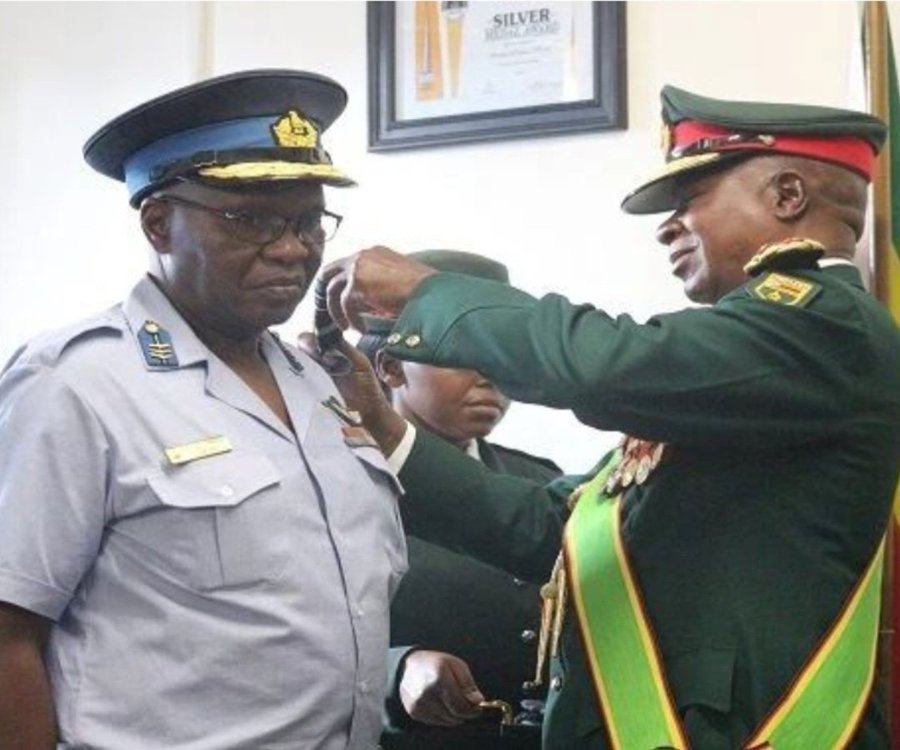
Vice-President Constantino Chiwenga is making his move. And while most Zimbabweans are distracted by economic chaos and daily survival, he is tightening his grip on the military with quiet precision. The recent appointment of Air Marshal John Jacob Nzvede to lead the Air Force of Zimbabwe was not just a change of command. It was a political statement. Nzvede replaces Elson Moyo, who recently retired, and joins Lieutenant-General Anselem Sanyatwe of the Zimbabwe National Army in a growing circle of military figures aligned with Chiwenga. This is not coincidence. It is strategy.
Nzvede and Sanyatwe are not just colleagues. They were both part of Chiwenga’s wedding committee when he married Colonel Miniyothabo Baloyi, a military intelligence officer. That wedding was more than a romantic occasion. It was a power display. A gathering of generals. A symbol of loyalty and unity within the armed forces around one man. And that man is not Emmerson Mnangagwa.
Chiwenga is building something. A fortress of loyal commanders. A base of power that looks more like a presidency-in-waiting than a deputy role. The timing is not accidental. Talk of Mnangagwa seeking a controversial third term has intensified. But the Constitution is not on his side. Neither, it seems, is the military. And that is what makes Chiwenga’s quiet moves so dangerous. They are precise, legal, and executed with the discipline of a soldier who knows the battlefield well.
This military-political entanglement is not new. Zimbabwe has always been shaped by generals and the gun. From the Mgagao Declaration to the 2017 coup that ended Mugabe’s rule, the military has always been the ultimate kingmaker. But now, the kingship itself is in dispute. And Chiwenga is making it clear that he has no intention of being sidelined again.
General Philip Valerio Sibanda’s possible retirement only raises the stakes. Mnangagwa has tried to reposition him politically, even floating the idea of placing him in the ZANU PF politburo. But resistance has been strong. The military does not want to be reduced to a pawn in a desperate president’s third-term game. Chiwenga knows this. He is capitalising on it.
The alliances Chiwenga is forming go beyond professional respect. They are deeply personal. They are built on trust formed in the trenches of military operations and reinforced by shared goals. These are not men who were merely appointed. These are comrades-in-arms, bound by history and ambition.
Mnangagwa may hold the title, but Chiwenga holds the command. And as every Zimbabwean knows, in this country, command is what matters. The presidency might be won through elections, but it is secured through barracks. Through salutes. Through loyalty pledged in silence behind high walls and dark uniforms.
What is unfolding is not just a succession battle. It is a test of what kind of country Zimbabwe will become. Will we continue to be ruled by military strongmen reshuffling ranks in the shadows? Or will civilians finally reclaim the democratic space long stolen by uniforms and bullets?
The international community must take note. This is not just political theatre. It is the prelude to something bigger. Something potentially explosive. Chiwenga is not speaking loudly. He does not need to. His actions speak clearly. The generals are aligning. The president is watching. And the people, as always, are left to wonder what comes next.
Zimbabwe’s future may once again be decided not at the ballot box but in the backrooms of army headquarters. And if Chiwenga plays his cards right, he may already have checkmated the entire board.
About The Author
